Skip Navigation
Book Now! Find care near you Find care near you Find care near you
wellstar-logo
Wellstar Go Back
Go to MyChart

Questions? We can help!

Call (770) 956-STAR (7827)

Monday - Friday, 7 AM - 4:30 PM

Contact Us
For Patients & Families For the Community For Providers About Us Careers
  • Start Your Care

  • Find a Doctor
  • Find a Location
  • Our Services
  • Virtual Visits
  • Planning

  • Accepted Insurance
  • Hospital Payment Planning
  • Financial Assistance
  • Pricing Information
  • Before Your Visit

  • Sign Up for MyChart
  • Visitation Guidelines
  • While You're Here

  • Support & Entertainment
  • Join an Event
  • After Your Visit

  • Pay Your Bill
  • Get Medical Records
  • Contact us
  • COVID-19 Support

  • COVID-19 Information
  • Vaccines
  • Testing Information
  • Foundation Relief
  • Community Care

  • In the Community
  • Health Highlights
  • Community Health Needs Assessment
  • Latest News
  • Center for Health Equity
  • Wellstar Find Help
  • Events & Programs

  • Events Calendar
  • On-Demand Classes
  • Support Groups
  • Give

  • Wellstar Foundation
  • Donate
  • Ways to Give
  • Thank a Caregiver
  • West Georgia
    Health Foundation
  • Volunteer

  • PeopleCare Advisory Council
  • For Adults
  • Care

  • Transfer a Patient
  • Cures Act
  • Refer a Patient
  • Lab Test Directory
  • Request to Conduct Research
  • Connect

  • Physician Relations
  • Request Imaging Services
  • Wellstar Clinical Partners
  • Wellstar Medical Group
  • Mayo Clinic Care Network
  • Medical Staff Services
  • Provider Recruitment
  • Log In

  • EpicCare Link
  • Lawson Connect
  • MyID Password Reset
  • Citrix Access
  • Leadership

  • Authority Board
  • Board Of Trustees
  • Foundation Board
  • Regional Health Boards
  • Executive Leadership
  • Awards, Recognition & Safety

  • Accreditation & Certifications
  • Awards & Recognition
  • Safety First Program
  • Nursing
  • Careers at Wellstar

  • Apply now
  • Upcoming virtual events
  • Why Wellstar?
  • Nursing Careers

  • Nursing (Direct Care)
  • Nursing Leadership
  • Nursing (Non-bedside)
  • Nursing Support
  • Physician, APP & Clinical Careers

  • Advanced Practice Providers (APPs)
  • Allied Health Professionals
  • Homecare & Hospice
  • Physicians
  • Support Team Careers

  • Administrative & Clerical
  • Coding, Compliance & HIM Systems
  • Facility, Environmental & Nutrition/Food Services
  • Information Technology & Systems
  • For Patients & Families
  • For the Community
  • For Providers
  • About Us
  • Careers
  • Search Search Search
  • MyChart MyChart MyChart

Start Your Care

Find a DoctorFind a LocationOur ServicesVirtual Visits

Planning

Accepted InsuranceHospital Payment PlanningFinancial AssistancePricing Information

Before Your Visit

Sign Up for MyChartVisitation Guidelines

While You're Here

Support & EntertainmentJoin an Event

After Your Visit

Pay Your BillGet Medical RecordsContact us

COVID-19 Support

COVID-19 InformationVaccinesTesting InformationFoundation Relief

Community Care

In the CommunityHealth HighlightsCommunity Health Needs AssessmentLatest NewsCenter for Health EquityWellstar Find Help

Events & Programs

Events CalendarOn-Demand ClassesSupport Groups

Give

Wellstar FoundationDonateWays to GiveThank a CaregiverWest Georgia
Health Foundation

Volunteer

PeopleCare Advisory CouncilFor Adults

Care

Transfer a PatientCures ActRefer a PatientLab Test DirectoryRequest to Conduct Research

Connect

Physician RelationsRequest Imaging ServicesWellstar Clinical PartnersWellstar Medical GroupMayo Clinic Care NetworkMedical Staff ServicesProvider Recruitment

Log In

EpicCare LinkLawson ConnectMyID Password ResetCitrix Access
About Wellstar

Our patients are the center of everything we do. We're nationally ranked and locally recognized for our high-quality care, inclusive culture, exceptional doctors and caregivers, and one of the largest and most integrated healthcare systems in Georgia.

About Us

Leadership

Authority BoardBoard Of TrusteesFoundation BoardRegional Health BoardsExecutive Leadership

Awards, Recognition & Safety

Accreditation & CertificationsAwards & RecognitionSafety First ProgramNursing

Careers at Wellstar

Apply nowUpcoming virtual eventsWhy Wellstar?

Nursing Careers

Nursing (Direct Care)Nursing LeadershipNursing (Non-bedside)Nursing Support

Physician, APP & Clinical Careers

Advanced Practice Providers (APPs)Allied Health ProfessionalsHomecare & HospicePhysicians

Support Team Careers

Administrative & ClericalCoding, Compliance & HIM SystemsFacility, Environmental & Nutrition/Food ServicesInformation Technology & Systems
Questions? We can help!

Call (770) 956-STAR (7827)

Monday - Friday, 7 AM - 4:30 PM

Contact Us
Close
  • Schedule With This Provider
  • Schedule At This Location
  • Schedule With This Provider
  • Schedule At This Location
  • Urgent Care
  • Primary Care
  • Virtual Care
  • Emergency Care
Close Close Close Book Now Menu
  • Schedule With This Provider
  • Schedule At This Location
  • Schedule With This Provider
  • Schedule At This Location
  • Urgent Care
  • Primary Care
  • Virtual Care
  • Emergency Care

Introducing

Wellstar Virtual Care

Access Wellstar healthcare providers
wherever you are.

Get started

Warning Warning Our "Book Now" feature should not be used for life threatening conditions such as heart attack, severe injury, poisoning, chest pain, or stroke. If you are experiencing such conditions, STOP and CALL 911 IMMEDIATELY or visit your nearest Emergency Department.

I Understand
  • Home
  • Articles
  • Lung Biopsy Technology at Wellstar Reduces Complications, Speeds Up Treatment
Article Category: Highlights

Lung Biopsy Technology at Wellstar Reduces Complications, Speeds Up Treatment

Published on October 29, 2024

Last updated 01:23 PM May 13, 2025

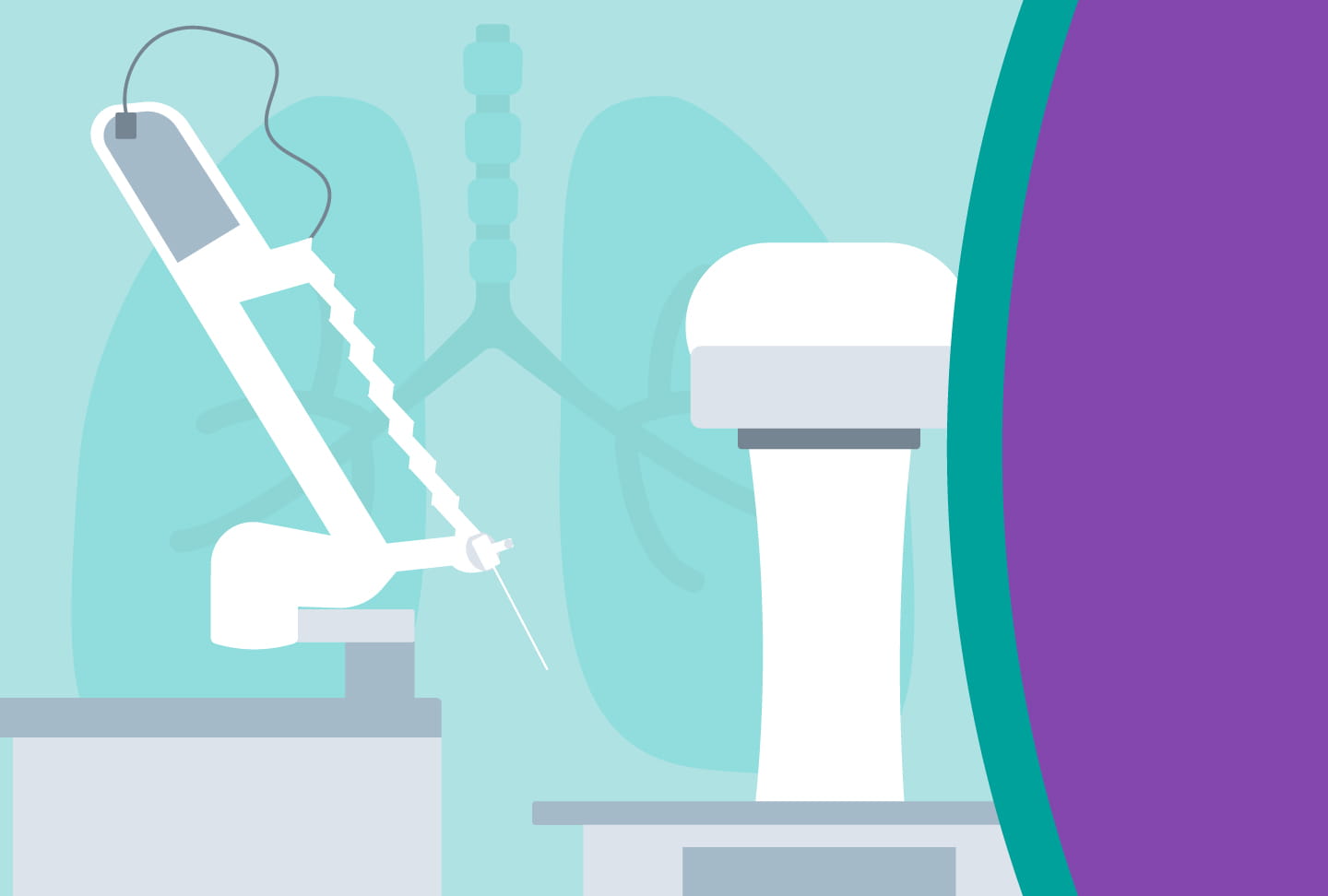
Illustration of Ion system

Innovative technology at Wellstar is offering patients a minimally invasive option for lung biopsies, reducing complications and helping expedite lung cancer treatment.

The Ion system is a robotic-assisted platform for performing lung biopsies. If a lung cancer screening or any other CT scan shows a suspicious nodule, providers will need to perform a biopsy to determine if the patient has lung cancer and how to proceed with care.

“Those nodules may not be cancer, but in certain situations we still need to know what it is,” said Wellstar Pulmonologist Dr. Timothy Udoji. “The Ion technology helps us biopsy those nodules to get an answer so that additional workup can be done immediately. If it is cancer, we want to catch it at an early stage.”

The system uses a three-dimensional spatial recognition technology that helps guide a catheter down the airway, deep into the lung, all the way to small nodules where biopsies can be performed. The robotic catheter maintains its shape and stability throughout the biopsy process significantly improving diagnostic yield compared to other modalities.

“The better the image and the more certainty we have of the spatial location of the catheter, the better we can avoid complications by making sure we are not too close to a blood vessel or the edge of the lung,” said Wellstar Thoracic Surgeon Dr. Daniel Fortes.

During the biopsy, providers can also use the Ion system to mark an area in the lung, making it easier to find later during surgery.

“If something is very small and hard to find in surgery, Ion can be used to mark that area with dye, or contrast, that allows us to find it in surgery,” Dr. Fortes said. “With this technology added to the surgical robotic system in the operating room, we can better identify those lesions and remove smaller portions of lung, also called segments.”

Technology to help provide peace of mind

The Ion system also has further reach than previous technologies and is able to more easily biopsy nodules in the peripheral areas of the lung. For many cancer patients, this will allow them to initiate care earlier and improve their outcomes, as well as give them peace of mind during the treatment process.

“Mental health impacts physical health. We are able to confidently biopsy and identify these nodules and that means a lot for our patients,” Dr. Udoji said. “Now, with this new technology we are able to get a biopsy done much earlier which has huge outcome implications for malignant nodules.”
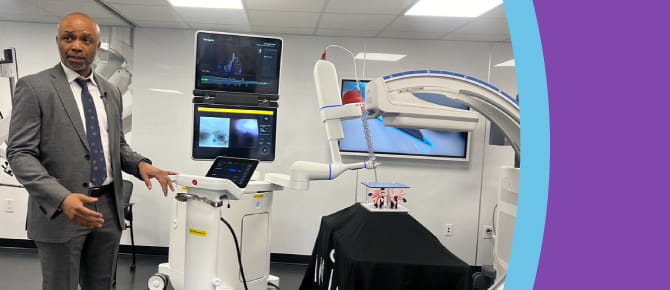
 

ION Robot surgery


At Wellstar, cancer care is tailored for each patient. In the Wellstar STAT Clinic for Lung Cancer, patients meet with multiple specialists at once to discuss their care options and create a personalized treatment plan. Specialists in the STAT Clinics, which are located at Wellstar Cobb, Douglas, Kennestone Regional, North Fulton, Paulding and West Georgia medical centers, as well as Cherokee Health Park, work with patients to determine the optimal course of treatment and will talk with patients and families about biopsy options, including the Ion system. The STAT Clinics give patients the opportunity to have their diagnoses managed right away, and literature shows that the clinics’ diagnostic and treatment model improves outcomes for patients.
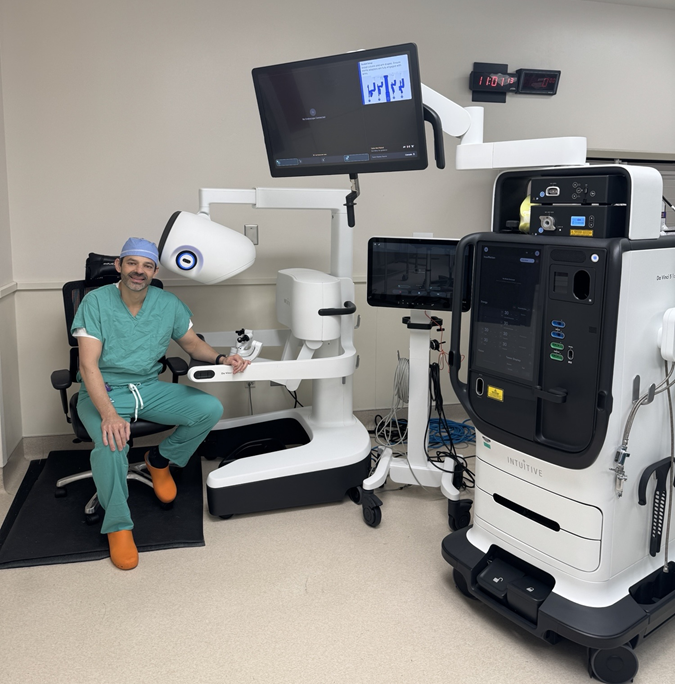

Photo of healthcare provider with ION system


The Ion system is in use at Wellstar Kennestone Regional Medical Center, where the team has completed more than 500 procedures. This system is also now available at Wellstar West Georgia Medical Center and Wellstar Douglas Medical Center. Learn more about lung cancer care at wellstar.org/lungcancer and ask your primary care provider or pulmonologist if you have questions or are seeking care for lung health. Learn more about pulmonary care at wellstar.org/pulmonary.


Tags

Kennestone Regional Medical Center Timothy Nnaemeka Udoji Daniel Leite Cardoso Fortes
STAT Clinic for Lung Cancer Cancer Care Pulmonary Care
Related Articles
Photo of inflatable colon

Highlights

Walk Through a 7-Foot Colon Model and Learn About Screenings at Wellstar Events

Early detection is the best prevention, especially when it comes to colon cancer. If caught early, colorectal cancer has a 91% survival rate.

For someone at average risk, screenings should begin at age 45. Those with a higher risk or a family history of colorectal cancer may need to start screening sooner. Talk to your care team to create a personalized screening plan.

To raise awareness of the importance of colon cancer screenings, Wellstar’s surgery, gastroenterology, cancer care and community health teams will host informational events throughout March. Visitors can walk through a large inflatable colon model, learn about the importance of screening and early detection, and at some events, nurses will be available to help patients schedule a colonoscopy.

  • March 6, 8 AM - 4 PM, Wellstar MCG Health Medical Center B Entrance 
  • March 6, 11 AM - 1 PM, Wellstar Kennestone Cancer Center
  • March 11, 10 AM - 2 PM, Wellstar Sylvan Grove Medical Center
  • March 12, 8 AM - 4 PM, Wellstar Spalding Medical Center
  • March 16, 8 AM - 4 PM, Wellstar Douglas Medical Center Main Lobby
  • March 17, 8 AM - 4 PM, Wellstar Paulding Medical Center Main Lobby (upstairs)
  • March 18, 10 AM - 2 PM, Wellstar Windy Hill Main Lobby
  • March 20, 8 AM - 4 PM, Wellstar West Georgia Medical Center Main Lobby
  • March 23, 8 AM - 4 PM, Wellstar East Cobb Health Park
  • March 24, 8 AM - 4 PM, Wellstar Avalon Health Park Lower Level Lobby
  • March 25, 8 AM - 4 PM, Wellstar Vinings Health Park
  • March 26, 8 AM - 4 PM, Wellstar Acworth Health Park
  • March 27, 8 AM - 4 PM, Wellstar Cherokee Health Park
  • March 31, 8 AM - 4 PM, Wellstar Cobb Medical Center

Call our colorectal cancer screening hotline at (470) 793-4032.

Photo of inflatable colon

Keep reading
Group of people eating

Highlights

Make Colon Health Your Habit

For many people, talking about colon health can be a little uncomfortable. However, medical issues don’t just go away if you ignore them.

Being proactive about your well-being with preventative care can help catch colorectal cancer or another serious condition early, often before it becomes a bigger problem.

Wellstar is committed to keeping your colon healthy with preventative screenings and expert care, so you can continue to live well.

Catch colon cancer early

Early detection is the best prevention, especially when it comes to colon cancer. If caught early, colorectal cancer has a survival rate of 91%.

“Colon cancer is the second most common cause of cancer death in the United States, so it’s very important that everyone gets screened,” said Wellstar Gastroenterologist Dr. Cameron Body. “For an average risk person, screenings should begin at age 45.”

Those with a higher risk or a family history of colorectal cancer may need to start screening sooner. Partner with your provider to create a personalized screening plan—and stick with it to stay ahead of the disease.

“Recently, colon cancer has been a major trending topic in public discourse, and it has been impacting younger individuals each year. It is important to start colon cancer screening at the age of 45 or sooner if you have a family history of colon cancer,” said Wellstar Gastroenterologist Dr. Shani Clay. “This is a preventable disease, so please speak with your primary care clinician or gastroenterologist to help get you screened. Colonoscopies can help prevent colon cancer, diagnose and help direct early treatment if you are diagnosed.”

The death rate for colon cancer in older adults has been decreasing for the past several decades due to screenings, according to the American Cancer Society. Screenings can identify polyps before they become cancerous and can catch cancer earlier when it is more easily treatable. However, in people under 55, death rates from colon cancer have been increasing by about 1% per year since the mid-2000s.

Why colonoscopies work

During a colonoscopy, a Wellstar gastroenterologist will view the inside of your colon and look for polyps or any other abnormal tissue that could be cancerous. This preventative testing is key to catching colorectal issues at the start.

“A colonoscopy is the gold standard when screening for colon cancer. The procedure itself is not painful, and we make sure you’re comfortable throughout the process,” Dr. Body said. “The goal is to do a high-quality exam with a good prep to find polyps when they’re small and get them removed to minimize the risk of them subsequently developing into cancer.”

Polyps take about five to 15 years to evolve into an invasive cancer, according to Dr. Carmen Klass, oncologist and hematologist with Northwest Georgia Oncology Centers, a care partner of Wellstar.

“If you have a colonoscopy every five to 10 years, they can remove the polyp and it will never be declared an invasive cancer,” Dr. Klass said. “In fact, if all Americans did their screening colonoscopies every five to 10 years, the death rate for colorectal cancer would drop by 50%.”

See how colorectal cancer screening saves lives.

Signs of colorectal cancer

  • Colon cancer is typically discovered when a patient has a colonoscopy, but it’s important to watch for these warning signs:
  • A change in your bowel habits, such as persistent diarrhea or constipation
  • Bloody stools or rectal bleeding
  • Abdominal discomfort, such as cramps, gas and pain
  • Feeling like you are unable to empty your bowels completely
  • Weakness or fatigue
  • Unexplained weight loss

If you experience any of these symptoms, contact your care team right away.

Colorectal cancer care at Wellstar

If you have been diagnosed with colorectal cancer, count on Wellstar for comprehensive, personalized care. Our specialists will work together with you to form a tailored treatment plan and offer support every step of the way.

“When a patient is diagnosed with cancer, we walk with them and guide them on this difficult journey,” Dr. Klass said, sharing how Wellstar provides compassionate care.

Wellstar offers medical expertise close to home, clinical trials and state-of-the-art surgical procedures to treat colorectal cancer. We also have a multidisciplinary gastrointestinal (GI) tumor board that diagnoses and creates treatment plans collaboratively.

Along with cancer surgeons, medical oncologists and other experts, our care team also includes nurse navigators, dietitians, social workers, psychologists, psychiatrists and counselors to provide complete care and support.

Learn how Wellstar cares for colorectal cancer.

Get answers with genetic testing

Whether you have been diagnosed with colorectal cancer or are concerned about the chance of developing it, genetic testing can help you understand your risk of getting the disease.

If your parent, sibling or child has had colorectal cancer, you are two to three times more likely to develop the condition compared with someone with no family history. Our genetic counselors can help determine how genetic testing could benefit you and your family.

“Wellstar offers support from genetic counselors to help keep other family members safe in the future,” Dr. Klass said.

Find out if genetic testing is right for you.

Keep reading
Thanks to a team of heart failure doctors and the Optimizer Heart Mini, Pat's back to dancing the Carolina shag again.

PeopleCare

PatCare

Pat Gelisse has been dancing for 30 years. She even taught the Carolina shag for a while. It’s a partner dance, sometimes compared to Swing dancing to beach music.

But severe heart failure downgraded Pat’s dancing queen status for close to 10 years.

“I went from feeling happy to feeling like a nothing,” she remembered of that time in her life.

With a team of Wellstar heart specialists working together for her, Pat found hope and new life on the dance floor.

Heart failure masquerades as acid reflux

It started more than a decade ago when Pat lived in central Georgia. She scheduled a doctor’s appointment for what she thought was acid reflux. She popped in on a quick break from her marketing job, assuming it wouldn’t take long.

Blood work and an EKG got Pat a ticket straight to the hospital and a quadruple bypass. 

“My heart got worse; it wasn’t pumping blood,” Pat said.

She was in acute heart failure, a life-threatening condition where the heart doesn’t pump well enough to deliver the necessary amount of oxygen to her body. Pat’s ejection fraction (EF)—the percentage measurement of the blood that leaves the heart each time it pumps—was only 10%. The normal range is 50 to 70%.

It was a scary time, and with a family history of heart problems, Pat was worried. She’d lost both parents to heart failure, as well as other family members.

“I just knew for sure I was going to be next,” said Pat.

Doctors from various academic institutions discussed serious treatments ranging from LVAD to transplant, but because the pumping performance of her heart improved, she was no longer a candidate for those procedures. Instead, Pat spent close to nine years managing her heart failure with a pacemaker and various medications—treatments that failed to get her back on the dance floor.

Keep reading
Back to Top
Branding illustration
Wellstar Logo
More than healthcare. PeopleCare.
Branding illustration
For Job Seekers & Team
Careers Diversity Equity Inclusion and Belonging Onboarding
For Students
Students Portal
Graduate Medical Education
Medical Residency Pharmacy Residency
For Business
Corporate Purchasing
For the Media
Media Room Community Health Needs Assessment
Help
Contact Us Pay Your Bill Policy & Privacy Information Hospital Transparency Information Price Transparency
For Job Seekers & Team
Careers Diversity Equity Inclusion and Belonging Onboarding
For Students
Students Portal

Graduate Medical Education
Medical Residency Pharmacy Residency
For Business
Corporate Purchasing
For the Media
Media Room Community Health Needs Assessment
Help
Contact Us Pay Your Bill Policy & Privacy Information Hospital Transparency Information Price Transparency

Copyright © 2026 Wellstar Health System. All Rights Reserved.

Wellstar does not discriminate on, exclude people or treat them differently on the basis of race, color, national origin, age, disability, sex, gender identity or expression or any other type of discrimination prohibited by law.

Cookie Preferences

We use cookies for booking and general analytics. Learn more about or internet privacy policy.