Skip Navigation
Book Now! Find care near you Find care near you Find care near you
wellstar-logo
Wellstar Go Back
Go to MyChart

Questions? We can help!

Call (770) 956-STAR (7827)

Monday - Friday, 7 AM - 4:30 PM

Contact Us
For Patients & Families For the Community For Providers About Us Careers
  • Start Your Care

  • Find a Doctor
  • Find a Location
  • Our Services
  • Virtual Visits
  • Planning

  • Accepted Insurance
  • Hospital Payment Planning
  • Financial Assistance
  • Pricing Information
  • Before Your Visit

  • Sign Up for MyChart
  • Visitation Guidelines
  • While You're Here

  • Support & Entertainment
  • Join an Event
  • After Your Visit

  • Pay Your Bill
  • Get Medical Records
  • Contact us
  • COVID-19 Support

  • COVID-19 Information
  • Vaccines
  • Testing Information
  • Foundation Relief
  • Community Care

  • In the Community
  • Health Highlights
  • Community Health Needs Assessment
  • Latest News
  • Center for Health Equity
  • Wellstar Find Help
  • Events & Programs

  • Events Calendar
  • On-Demand Classes
  • Support Groups
  • Give

  • Wellstar Foundation
  • Donate
  • Ways to Give
  • Thank a Caregiver
  • West Georgia
    Health Foundation
  • Volunteer

  • PeopleCare Advisory Council
  • For Adults
  • Care

  • Transfer a Patient
  • Cures Act
  • Refer a Patient
  • Lab Test Directory
  • Request to Conduct Research
  • Connect

  • Physician Relations
  • Request Imaging Services
  • Wellstar Clinical Partners
  • Wellstar Medical Group
  • Mayo Clinic Care Network
  • Medical Staff Services
  • Provider Recruitment
  • Log In

  • EpicCare Link
  • Lawson Connect
  • MyID Password Reset
  • Citrix Access
  • Leadership

  • Authority Board
  • Board Of Trustees
  • Foundation Board
  • Regional Health Boards
  • Executive Leadership
  • Awards, Recognition & Safety

  • Accreditation & Certifications
  • Awards & Recognition
  • Safety First Program
  • Nursing
  • Careers at Wellstar

  • Apply now
  • Upcoming virtual events
  • Why Wellstar?
  • Nursing Careers

  • Nursing (Direct Care)
  • Nursing Leadership
  • Nursing (Non-bedside)
  • Nursing Support
  • Physician, APP & Clinical Careers

  • Advanced Practice Providers (APPs)
  • Allied Health Professionals
  • Homecare & Hospice
  • Physicians
  • Support Team Careers

  • Administrative & Clerical
  • Coding, Compliance & HIM Systems
  • Facility, Environmental & Nutrition/Food Services
  • Information Technology & Systems
  • For Patients & Families
  • For the Community
  • For Providers
  • About Us
  • Careers
  • Search Search Search
  • MyChart MyChart MyChart

Start Your Care

Find a DoctorFind a LocationOur ServicesVirtual Visits

Planning

Accepted InsuranceHospital Payment PlanningFinancial AssistancePricing Information

Before Your Visit

Sign Up for MyChartVisitation Guidelines

While You're Here

Support & EntertainmentJoin an Event

After Your Visit

Pay Your BillGet Medical RecordsContact us

COVID-19 Support

COVID-19 InformationVaccinesTesting InformationFoundation Relief

Community Care

In the CommunityHealth HighlightsCommunity Health Needs AssessmentLatest NewsCenter for Health EquityWellstar Find Help

Events & Programs

Events CalendarOn-Demand ClassesSupport Groups

Give

Wellstar FoundationDonateWays to GiveThank a CaregiverWest Georgia
Health Foundation

Volunteer

PeopleCare Advisory CouncilFor Adults

Care

Transfer a PatientCures ActRefer a PatientLab Test DirectoryRequest to Conduct Research

Connect

Physician RelationsRequest Imaging ServicesWellstar Clinical PartnersWellstar Medical GroupMayo Clinic Care NetworkMedical Staff ServicesProvider Recruitment

Log In

EpicCare LinkLawson ConnectMyID Password ResetCitrix Access
About Wellstar

Our patients are the center of everything we do. We're nationally ranked and locally recognized for our high-quality care, inclusive culture, exceptional doctors and caregivers, and one of the largest and most integrated healthcare systems in Georgia.

About Us

Leadership

Authority BoardBoard Of TrusteesFoundation BoardRegional Health BoardsExecutive Leadership

Awards, Recognition & Safety

Accreditation & CertificationsAwards & RecognitionSafety First ProgramNursing

Careers at Wellstar

Apply nowUpcoming virtual eventsWhy Wellstar?

Nursing Careers

Nursing (Direct Care)Nursing LeadershipNursing (Non-bedside)Nursing Support

Physician, APP & Clinical Careers

Advanced Practice Providers (APPs)Allied Health ProfessionalsHomecare & HospicePhysicians

Support Team Careers

Administrative & ClericalCoding, Compliance & HIM SystemsFacility, Environmental & Nutrition/Food ServicesInformation Technology & Systems
Questions? We can help!

Call (770) 956-STAR (7827)

Monday - Friday, 7 AM - 4:30 PM

Contact Us
Close
  • Schedule With This Provider
  • Schedule At This Location
  • Schedule With This Provider
  • Schedule At This Location
  • Urgent Care
  • Primary Care
  • Virtual Care
  • Emergency Care
Close Close Close Book Now Menu
  • Schedule With This Provider
  • Schedule At This Location
  • Schedule With This Provider
  • Schedule At This Location
  • Urgent Care
  • Primary Care
  • Virtual Care
  • Emergency Care

Introducing

Wellstar Virtual Care

Access Wellstar healthcare providers
wherever you are.

Get started

Warning Warning Our "Book Now" feature should not be used for life threatening conditions such as heart attack, severe injury, poisoning, chest pain, or stroke. If you are experiencing such conditions, STOP and CALL 911 IMMEDIATELY or visit your nearest Emergency Department.

I Understand
  • Home
  • Articles
  • JohnCare
Article Category: PeopleCare

JohnCare

Published on November 25, 2024

Last updated 01:25 PM November 25, 2024
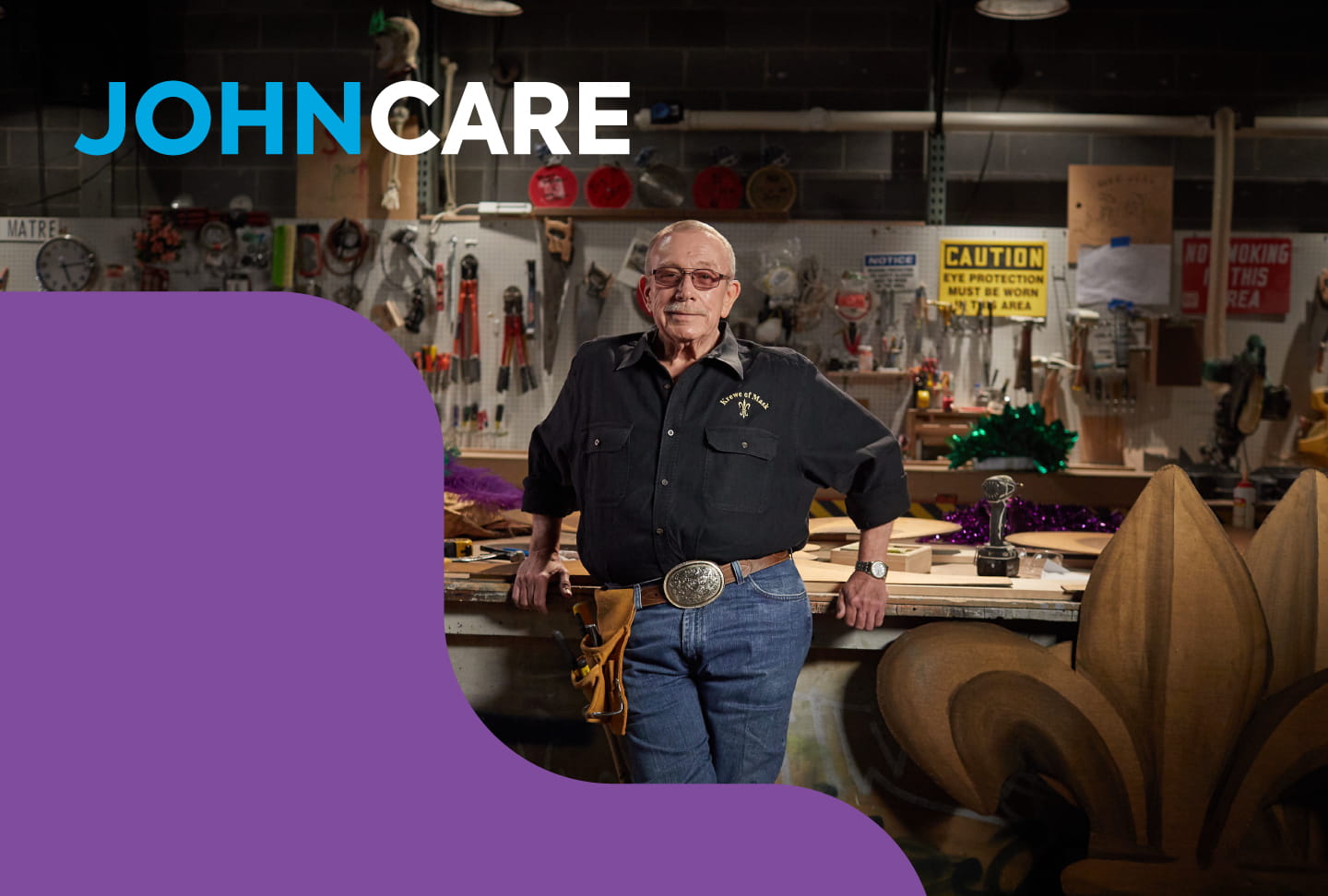
John in is workshop

A master of everything Mardi Gras, John runs a local krewe and is a natural at building parade floats from the foundation up.

It seems "defeat" just isn't in John Cashen's vocabulary. A survivor in more ways than one, John has overcome not only a catastrophic natural disaster, but also fought cancer with unyielding resilience.

In 2005, as flood waters from Hurricane Katrina rose and threatened his New Orleans home, John took an axe to his attic's ceiling, climbed atop his roof and tied himself to his chimney so he wouldn't be swept away. Days later, no help had arrived, so John untied himself and swam to an overpass where he was rescued by a helicopter. He joined the rest of his family in Georgia.

Since then, John has become a proud citizen of LaGrange. A master of everything Mardi Gras, John runs a local krewe and is a natural at building parade floats from the foundation up. But when he was diagnosed with lung cancer in 2019, he summoned his fighting spirit, squared his shoulders, and faced his cancer journey head on.

For patients like John, there’s a lot of different aspects we take into consideration when creating a treatment plan. We pull all factors together—like general health, medicines, personal preferences and family concerns—to create the best care plan possible.

- Dr. Robert Taylor

Wellstar Radiation Oncologist

Listen to John's story

A troubling diagnosis

It all began with lung discomfort and tiredness that he just couldn't shake, no matter how much sleep he had each night. Concerned, he visited his primary care provider to get to the bottom of the issue.

After John's vital signs revealed low blood pressure, the doctor sensed something bigger might be happening behind the scenes. John underwent diagnostic testing, including bloodwork and X-rays, to find the cause of his fatigue.

"When the X-rays came back, my doctor noticed a spot in the upper left lobe of my lungs," John said, remembering the fuzzy dot on the X-ray screen. "I had been feeling tired and run down, but overall, I didn't feel that bad."

The troubling results pointed to a clear answer: lung cancer. Even though John didn't notice many red flags when it came to his health, his body was battling a disease he couldn't see.

According to Mayo Clinic, many patients may not experience any symptoms in the early stages of lung cancer. Once the warning signs—such as coughing, shortness of breath, chest pain and hoarseness—set in, the disease may already be at an advanced stage.

After a round of CT and PET scans, the concerning lung spot appeared to be growing in size, even after just a short few days.

Without delay, John was on a mission to find the right health partner to treat his lung cancer before it had the chance to spread.


Cutting-edge cancer care

Soon after the concerning X-ray results, John sought out the medical opinions of several different doctors. All of the professionals recommended a biopsy and other surgical means to treat his cancer.

However, John was firmly against any invasive treatments. That's when he crossed paths with Wellstar Radiation Oncologist Dr. Robert Taylor, who suggested a solution.

"When John first came into the office, he was very worried about the prospect of surgery," Dr. Taylor said, recalling their first meeting at Wellstar West Georgia Medical Center. "He knew about many cancer treatments and was seeking the least invasive option possible."

After discussing John's concerns about surgery, the physician suggested an innovative cancer treatment called stereotactic ablative radiotherapy (SABR).

"SABR is like virtual surgery. Using X-ray technology, you can "reach" inside of a patient and virtually cut out the tumor," Dr. Taylor explained. "When the patient leaves a treatment session, they feel the same as when they entered. There is no surgery or downtime."

For John, this was the perfect, non-invasive option to take care of his cancer, quickly and effectively. He also left the consultation feeling like an equal partner in the process.

"Dr. Taylor explained everything to me clearly," John said. "He knew I wasn't a physician, so he spoke to me in a way that I could understand and laid out all my treatment options."

When building a custom care plan for any patient, Wellstar always takes a personalized approach.

"For patients like John, there's a lot of different aspects we take into consideration when creating a treatment plan," Dr. Taylor shared. "We pull all factors together—like general health, medicines, personal preferences and family concerns—to create the best care plan possible."

With a clear path forward and renewed hope, John felt confident trusting Wellstar with his lung cancer care.


Care right around the corner

A short time later, John began SABR treatments at Wellstar West Georgia Medical Center. With the most advanced cancer technology right in LaGrange, he didn't have to travel out of his way for treatment.

For the hard-working father and grandfather, the access to quick and convenient cancer treatments fit right into his busy schedule.

"Typically, this type of radiotherapy is delivered in about five separate treatments, in 30-minute intervals," Dr. Taylor said, explaining how the specialized treatment works. "The sessions are often done just a few days apart."

Without any incisions or other invasive measures, SABR uses concentrated radiation beams to target tumors precisely. Because his lung cancer was localized, the focused doses could treat the affected areas without damaging the healthy tissues.

Dr. Taylor was pleased with John's health progress throughout the treatment, and his prognosis was quickly looking up.

"John had no side effects and responded very well to treatment," said Dr. Taylor. "One time, he even asked if the machine was turned on because he couldn't feel a thing."

From start to finish, John kept a positive attitude about his cancer care. "The treatments weren't painful. It was a half-hour long, so just long enough for a good nap."

Wellstar offered support every step of the way, addressing John's concerns and crafting an effective cancer treatment plan. But the care didn't end when he left the building.

"During my treatment, the Wellstar team helped me through everything. Afterward, they would call me often to see how I was feeling and ask if I was eating enough," John beamed. "Wellstar is full of caring people. It's not just for show."

The radiation sessions were successful. Just months after the initial diagnosis, John was pronounced cancer-free. His yearly scan and monthly check-ins have all shown no signs of the disease returning either.

Now, John can get back to life and what really matters: planning his annual Mardi Gras parade for family and friends. Moving forward, he will always consider Wellstar to be an essential part of his health krewe.

"My Wellstar care team made me feel like I was a person, not an object they were trying to fix. Nobody treats you like Wellstar."

Tags

West Georgia Medical Center Robert B Taylor Jr Cancer Care
Read related articles
Healthcare provider listens to his patient's lungs using a stethoscope

Highlights

What Happens After an Abnormal Lung Screening

The Weekly Check-up Atlanta


Annual lung cancer screenings are recommended preventive screenings—much like mammograms and colonoscopies. Yet in Georgia, fewer than 14% of patients who are eligible for lung cancer screenings get them.

Why the hesitation?

According to Dr. Daniel Fortes, a board-certified thoracic surgeon at Wellstar, the reasons for hesitation may include:

  • Guilt: “I smoked. If there’s a problem, I caused it.”
  • A lack of awareness about screening and insurance coverage
  • Fear that screening will find something abnormal

It's important for current and former smokers age 50 and older to champion their health and stay up to date on lung screenings. When caught early, lung cancer is more treatable and likely curable.

“Wellstar puts our patients at the center of their care,” Dr. Fortes said. “We do everything to minimize patient anxiety and maximize the speed at which they travel through the system, so that we can get them to their treatment as quickly as possible.”

What is lung cancer screening?

Lung cancer is the leading cause of cancer deaths among men and women. For many years, most cases were not detected until the disease was already advanced.

That began to change about 20 years ago. Research revealed that screenings with low-dose CT scans were finding cancer earlier, at a stage that is far more treatable. Today, we know that annual low-dose CT screenings for individuals at high risk have been shown to reduce lung cancer deaths by about 20%.

“That was a breakthrough,” Dr. Fortes said. “It was the first time we knew that there was something we could do to decrease the mortality of lung cancer proactively.”

The U.S. Preventive Services Task Force, a government agency, added annual lung cancer screenings to its list of recommended screenings. Medicaid, Medicare and most private insurance plans began covering the costs for patients over 50 whose smoking histories put them at risk.

The screening is painless and fast. Sometimes, the CT scan reveals a lung nodule, or a small, round growth. But not all nodules are cancerous. Old infections, scarring or inflammation can cause benign (non-cancerous) nodules. If the scan is abnormal, the patient will be referred to a Wellstar STAT Clinic for Lung Cancer.

Shorter time from diagnosis and treatment

At Wellstar, STAT Clinics (short for Specialty Teams and Treatments) provide dedicated guidance and help shorten the time from diagnosis to treatment. Within the STAT Clinic for Lung Cancer, the multidisciplinary care team may include a surgeon, pulmonologist, medical oncologist, radiation oncologist and a nurse navigator.

Before a patient visits the STAT Clinic, their team meets to review their scan and develop an initial plan. The patient and their family then meet with the appropriate team members on the same day. Their nurse navigator provides education, support and advocacy from diagnosis through treatment and recovery.

“This takes away a lot of anxiety from patients who are running from one office to another without an answer,” Dr. Fortes said. “They have a defined plan, and we expedite everything. Things happen much faster. Our average is about four to six weeks total from when we first identify a problem to the time a patient receives treatment. That’s compared to four months nationwide—and we’re trying to decrease the time even more.”

Advancements in lung cancer treatment

For patients with early-stage lung cancer, surgery to remove the affected portion of the lung and surrounding lymph nodes is often the center of the treatment plan.

“Many patients with early-stage cancer are candidates for minimally invasive techniques, either by video techniques or robotics,” Dr. Fortes said. “These techniques require small incisions in the chest without much disruption or trauma to the chest wall.”

As a result, patients have less pain after surgery and recover faster. They often leave the hospital after a day or two.

“There have been so many advancements that have changed lung cancer care,” Dr. Fortes said. “When we find lung cancer at the earliest stages and patients have surgery, they have up to an 85% chance of being cured.”

Who should get annual lung cancer screening

If you are 50 or older, currently smoke or smoked in the past, ask your healthcare provider if you should have lung cancer screenings.

The American Lung Association and the U.S. Preventive Services Task Force recommend annual screening for adults 50 to 80 who have a 20 pack-year smoking history. That could mean one pack a day for 20 years or two packs a day for 10 years.

The guidelines apply whether you still smoke or have quit within the past 15 years. You do not need to have symptoms to be screened.

Remember: Finding cancer early, when no symptoms are present, increases your chances of being cured or living longer with lung cancer.

Take the next steps toward screening

  • Learn more about lung cancer screening at Wellstar.
  • Call (470) 793-4AIR to learn more about eligibility, financial assistance or to schedule a screening.
  • Read about a patient whose lung cancer screening results showed cancer in an early stage.
  • Need a doctor? Find a Wellstar provider and book an appointment.
Keep reading
Clinician looking through microscope

Highlights

Genetic Testing: A Critical Tool in Cancer Treatment

It's been over three decades since genetic testing was first introduced as a tool for patients at risk of hereditary cancer syndromes. In its early days, genetic testing was expensive and time-consuming (often taking up to eight weeks for results). Fast forward to today and genetic testing is now a routine part of cancer care. It’s more accessible, comprehensive and, perhaps most importantly, significantly impactful for patients and their families.

Physicians help identify patients who could benefit from genetic testing, especially when someone has a personal or family history of cancer. Genetic testing can improve treatment outcomes, guide preventive care and provide vital information for the patient's family.

Benefits of genetic testing

1. Understanding the cause of cancer

One of the most common questions from patients newly diagnosed with cancer is, "Why did this happen to me?" While many cancers are the result of environmental factors, aging and sporadic mutations, genetic testing can offer a more definitive answer. For patients with hereditary cancer, knowing their cancer is genetically driven can help ease feelings of uncertainty and guilt. 

For many, this knowledge brings a sense of empowerment, as they now have the opportunity to make informed decisions regarding their treatment and potential preventive measures for the future. This hereditary cancer risk was present since birth, and there was very little if anything the patient could have done differently throughout their life to prevent their diagnosis.

2. Personalized treatment options

For patients with cancers like breast, ovarian, pancreatic and prostate, identifying genetic mutations (like BRCA mutations) can open the door to personalized therapies. The earlier in the diagnostic process the genetic test is ordered, the quicker the patient can be matched with appropriate treatments.

Knowledge of genetic mutations can also guide surgical decisions. Patients with BRCA-positive breast cancer may be candidates for risk-reducing mastectomy or salpingo-oophorectomy—both of which can lower the risk of future cancers. These decisions are most effective when genetic results are available before surgery.

3. Identification of additional cancer risks

Cancer does not always occur in isolation, especially in patients with hereditary cancer syndromes. For instance, patients with Lynch syndrome, a leading cause of colorectal cancer, are also at increased risk for uterine cancer—up to 60%. If identified before a colon resection, this knowledge could allow a hysterectomy at the same time if necessary, minimizing the risk of a second cancer and optimizing care.

Beyond immediate cancer treatment, genetic testing can also lead to additional screenings that might otherwise be missed. For example, the ATM gene is a known contributor to prostate and breast cancer.  But patients with an ATM gene mutation are also at elevated risk for pancreatic cancer. While general population screening is not typically recommended, high-risk patients should begin annual imaging and/or endoscopic ultrasounds as early as age 50 or 10 years before the earliest known pancreatic cancer in their family.

4. Informed decisions for family members

A cancer diagnosis doesn’t only affect the patient—it impacts their entire family. Once a genetic mutation is identified, relatives can undergo testing to assess their own cancer risk and talk to their care teams about screenings. 

Testing the affected patient first is the most informative strategy for relatives. Patients with negative genetic test results can be reassured that relatives are not at significant risk for the same diagnosis. 

The role of genetic counseling in cancer care

Genetic counselors provide the expertise necessary to interpret complex genetic results, discuss the implications for patients and their families, and offer psychological support throughout the process. Genetic counseling not only helps patients make sense of their genetic test results, but also provides them with the tools to make informed decisions about their health.

Counseling also helps address the emotional and psychological aspects of genetic testing, from potential feelings of anxiety to guilt and even empowerment. Research shows that genetic counseling has a positive impact on patient knowledge, reduces anxiety and can improve overall psychological well-being during a cancer journey.

Learn more about genetic counseling at Wellstar. 

Keep reading
Celebrating the ribbon-cutting at Wellstar's newest cancer care facility in Cartersville, Georgia

Newsroom

Wellstar Expands Cancer Care in Cartersville

CARTERSVILLE, Ga. — Community members, local officials and healthcare leaders gathered to celebrate the ribbon cutting of Wellstar’s newest cancer care facility, marking a significant milestone in expanding oncology services for Bartow County. The facility began seeing patients Feb. 23, but the event offered the community its first look inside the expanded space and an opportunity to recognize the teams behind the project.

The nearly 15,000-square-foot building doubles local infusion capacity and adds space for chemotherapy, immunotherapy, targeted therapy and other medical oncology ervices. The facility features 15 exam rooms, three triage rooms, 28 infusion chairs, eight blood draw stations, a dedicated laboratory, an on-site compounding pharmacy, and expanded areas for clinical consultations and care coordination.

“This new facility is part of our commitment to expanding access to compassionate, high-quality care across the Southeast,” said Ketul J. Patel, president and CEO of Wellstar Health System. “For the people who call Bartow County home, that commitment means advanced cancer treatment where they live, delivered by a team supporting them every step of the way.”

The new location expands cancer care with Wellstar and partners in care Northwest Georgia Oncology Centers, enabling access to the latest therapies and strengthening collaboration among oncologists, advanced practice providers, pharmacists and support teams. In Cartersville, a dedicated team of two medical oncologists and four advanced practice providers now delivers personalized treatment plans tailored to each patient’s diagnosis. Patients also have access to supportive services, including genetic counseling, financial navigation and education with a clinical pharmacist.

Collage of staff and facility photos of Wellstar's cancer care facility in Cartersville, Georgia


“This space was designed with our patients’ needs in mind,” said Dr. Michelle Ojemuyiwa, a Wellstar oncologist and hematologist who practices in Cartersville. “With more room, additional infusion chairs and an on-site compounding pharmacy, we can care for more patients efficiently while maintaining the personalized, attentive approach they expect throughout their treatment.”

The new Wellstar cancer care facility is located at 65 Cloverleaf Drive in Cartersville.

Keep reading
Back to Top
Branding illustration
Wellstar Logo
More than healthcare. PeopleCare.
Branding illustration
For Job Seekers & Team
Careers Diversity Equity Inclusion and Belonging Onboarding
For Students
Students Portal
Graduate Medical Education
Medical Residency Pharmacy Residency
For Business
Corporate Purchasing
For the Media
Media Room Community Health Needs Assessment
Help
Contact Us Pay Your Bill Policy & Privacy Information Hospital Transparency Information Price Transparency
For Job Seekers & Team
Careers Diversity Equity Inclusion and Belonging Onboarding
For Students
Students Portal

Graduate Medical Education
Medical Residency Pharmacy Residency
For Business
Corporate Purchasing
For the Media
Media Room Community Health Needs Assessment
Help
Contact Us Pay Your Bill Policy & Privacy Information Hospital Transparency Information Price Transparency

Copyright © 2026 Wellstar Health System. All Rights Reserved.

Wellstar does not discriminate on, exclude people or treat them differently on the basis of race, color, national origin, age, disability, sex, gender identity or expression or any other type of discrimination prohibited by law.

Cookie Preferences

We use cookies for booking and general analytics. Learn more about or internet privacy policy.